
Most people have a pretty good idea of what they like. They've saved images on Pinterest, followed a few designers on Instagram and developed a collection of ideas for the kitchen, bathroom or renovation they've been dreaming about.
They know they like natural stone. They're drawn to timber cabinetry. They've found a beautiful tile and know exactly which tapware they'd choose.
And that's a great starting point.
But here's something worth considering: knowing what you like and knowing how to create a successful home are two quite different things.
Because some of the most important design decisions aren't necessarily the ones you'll notice first. And they're often the ones you don't know you need to make.
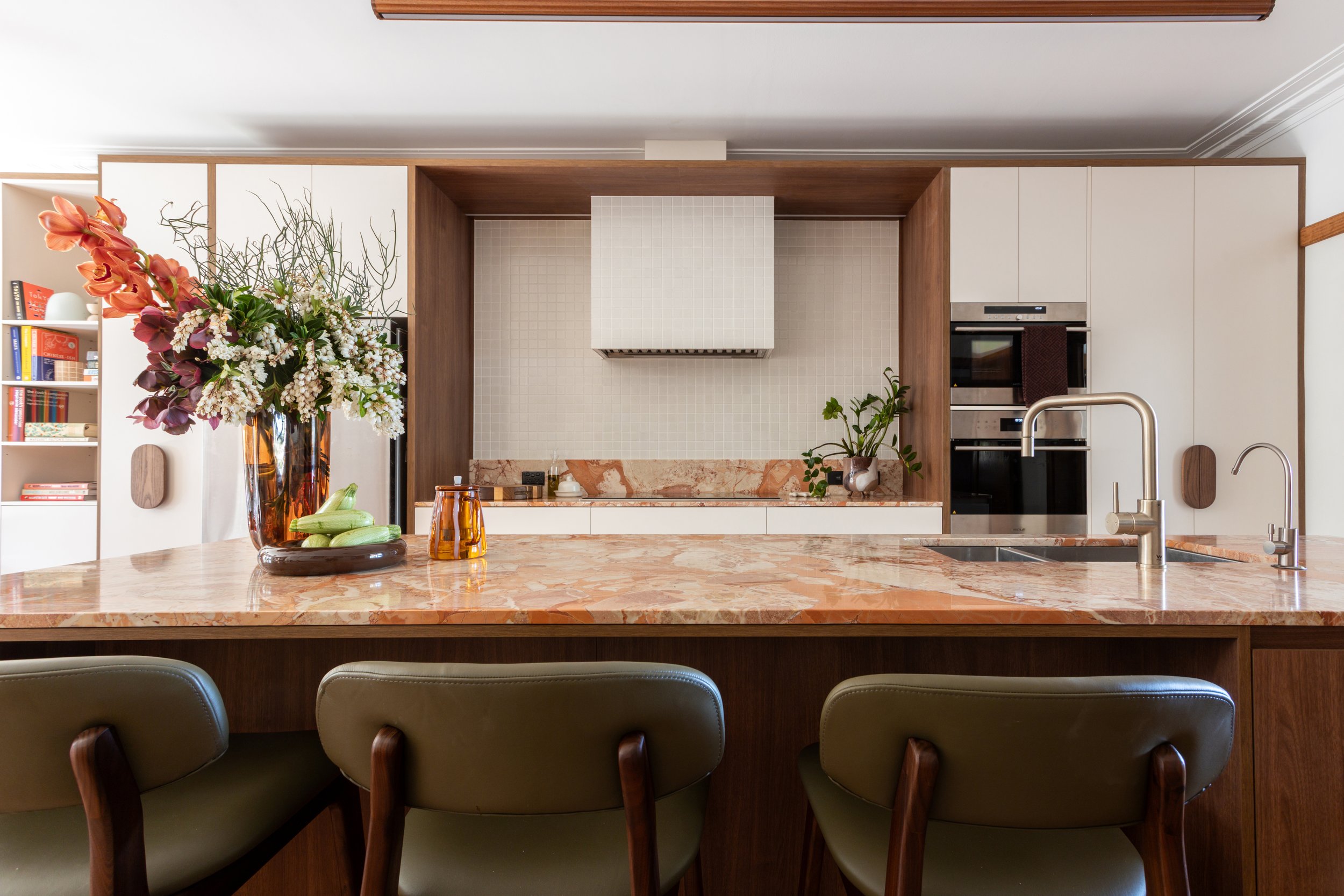
Barcelona House - a considered and detailed response to a period home with new extension.
It's what you don't know you don't know.
Interior design is often perceived as the fun part of a renovation. Choosing colours, materials, finishes and fixtures. Making things look beautiful.
And while that's certainly part of it, there's a considerable amount of thinking that happens before those decisions are made. How do you move through a space? Where should the storage go? Is the kitchen layout genuinely functional? How does natural light change throughout the day? Will the materials you've selected work together, both visually and practically?
These aren't always obvious questions, particularly when you're looking at a room in isolation.
A designer brings a different perspective. The ability to look beyond the immediate problem, recognise opportunities and consider how a series of individual decisions will influence the finished home.
It's often the difference between getting a renovation completed and achieving an outcome that genuinely exceeds expectations.
Spatial planning: making the space work harder.
A beautiful kitchen that doesn't function properly is still a poorly designed kitchen. The same applies to bathrooms, living areas and the spaces in between.
Spatial planning is about understanding how a home works as a whole. It's considering circulation, proportions, clearances, sightlines, storage, furniture placement and the relationship between adjoining spaces.
Sometimes a relatively small change to a floor plan can make an enormous difference to how a home feels and functions.
An awkward corner might become valuable storage. A poorly positioned doorway might be restricting the flow between rooms. A kitchen island might look impressive on paper but leave insufficient circulation space in reality.
These are the decisions that need to be resolved early, before cabinetry is manufactured, materials are ordered and construction begins.
Lighting: more than choosing a pendant.
Lighting is one of the most overlooked elements of residential design, yet it has an enormous influence on how a home feels. It's not simply a matter of selecting a beautiful pendant over the dining table.
Good lighting design considers natural light, task lighting, ambient lighting and accent lighting. It looks at how different spaces are used, where light is needed and how it can be layered to create atmosphere.
In a kitchen, for example, you need appropriate illumination for preparation and cooking, but you also want the space to feel warm and inviting when you're entertaining.
In a bathroom, lighting needs to work practically at the vanity while creating a more relaxed environment elsewhere.
Getting these decisions right requires consideration early in the design process. Retrofitting lighting once ceilings, cabinetry and finishes are complete is rarely ideal. And neither is the grid of downlights your electrician recommended.
Materials and finishes: knowing what works together.
This is where things can get particularly interesting.
You might love a particular stone, tile or timber finish. But will it work with the other materials you've selected? Is it suitable for the application? Will it age well? How will its texture, colour and reflectivity interact with the surrounding finishes?
A material can look wonderful in a showroom and behave quite differently in your home. There are practical considerations, too. Durability, maintenance, installation requirements, availability, lead times and suitability for the intended application all matter.
The goal isn't simply to select beautiful individual products. It's to create a considered material palette where everything has a reason for being there. Sometimes that means knowing when to introduce contrast, when to pull back and when a particular finish simply isn't the right choice.
And occasionally, it means talking you out of something you absolutely love. That's part of the job.
The bigger picture: designing a home, not a collection of rooms.
One of the most significant benefits of engaging an interior designer is having someone consider the entire picture. It's easy to approach a renovation room by room. The kitchen gets updated this year, the bathroom next year and the living room whenever the budget allows.
But without an overarching design direction, individual spaces can end up feeling disconnected.
The materials might not relate. The colours might compete. The detailing might vary. And while each room might look perfectly good on its own, the home as a whole can lack cohesion.
A considered design approach establishes a relationship between spaces.
It considers the architecture of the home, existing features worth retaining, the natural environment, material transitions, colour palettes and the way each space connects to the next. This doesn't mean every room needs to look the same. Quite the opposite.
A cohesive home can have plenty of personality, colour and contrast. The difference is that those decisions are intentional, and there's a thread connecting them.
It's the decisions you make before construction that matter most.
By the time a renovation reaches construction, many of the most important design decisions should already have been made.
The layout, cabinetry, lighting, materials, finishes, fixtures and detailing need to be resolved sufficiently for the people building your home to understand exactly what's required. Without that clarity, decisions are often made on the fly.
A measurement changes. A finish isn't available. An electrical point is in the wrong place. A detail hasn't been considered. Suddenly, you're making expensive decisions under pressure, with limited time to explore alternatives.
Good design documentation and planning help reduce these risks. They provide direction, communicate intent and give your trades a much clearer understanding of the finished result.
It's not about eliminating every unexpected challenge. Renovations will always have their moments. It's about having a considered plan and the expertise to navigate the process when things don't go exactly to plan.
So, what are you actually investing in?
When you engage an interior designer, you're not simply paying someone to select tiles, colours and cabinetry. You're investing in experience, problem-solving, design thinking and a level of detail that comes from understanding how all the individual elements of a home work together.
You're investing in decisions made with the benefit of professional knowledge, rather than having to learn everything through research, trial and error.
And perhaps most importantly, you're investing in the opportunity to get the outcome right. A successful renovation isn't measured solely by whether the building work is finished or whether the kitchen looks good in photographs.
It's measured by how well your home works, how it makes you feel and how much you enjoy living in it long after the builders have packed up.
Because good design isn't just about what you see. It's about everything that goes into making a home work beautifully.
At Assembly Interiors, we bring together spatial planning, material knowledge, considered detailing and a cohesive design approach to create homes that are as functional as they are beautiful.
The things you don't know you don't know? That's where we come in. Let's start with a conversation about what's not working, and what could. Reach out to see how we can help.